Giving Thanks for Wendell Berry, 1934–2026
In 1989, author Wendell Berry wrote in an essay that, “Eating is an agricultural act.” That sentence, written 37 years ago, has quietly become one of the guiding principles that has lived at the heart of the Center for a Livable future (CLF) since its founding almost 30 years ago.
Mr. Berry died on August 31 at the age of 92, at his home in Port Royal, Kentucky. In obituaries about him, one of the major U.S. newspapers refers to him as “the prophet of the unplugged,” and another refers to him as a “Kentucky farmer.” In 2011, President Obama presented him with the National Humanities Medal, which described him as a “poet, novelist, farmer and conservationist.”
Within the food systems world, Mr. Berry is widely regarded as the father of regenerative agriculture and the sustainable food movement. He helped carry forward the work of earlier pioneers like George Washington Carver and Sir Albert Howard.
He was certainly a literary powerhouse, and his most famous book, The Unsettling of America: Culture and Agriculture, written in 1977, is regarded as, perhaps, a manifesto about how agribusiness, corporate monopolies, and federal policies like Nixon-era Agriculture Secretary Earl Butz’s “get big or get out” have paved the way for pollution, soil loss, commodification of food, loss of livelihood for farmers, and the degradation of rural communities.
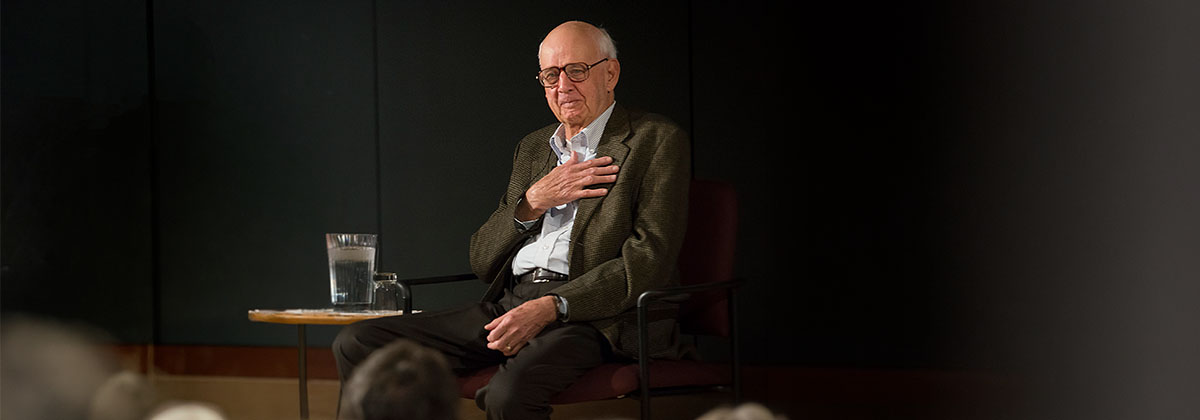
Ten years ago, on December 7- 8, 2016, Mr. Berry visited the Bloomberg School, hosted by the Center, and he gave the annual Dodge Lecture. As part of the lecture, he read aloud “The Thought of Limits in the Prodigal Age,” which had not yet been published. (It was later included in his essay collection, The Art of Loading Brush.)
Mr. Berry’s visit to the Center took place one month after Donald Trump had been elected President for the first time. There was a palpable solemnity in the air, and during the Q&A, many in the audience in the filled-to-capacity lecture room expressed shock and sadness at the election’s outcome. One member of the audience asked Mr. Berry for guidance for the new era that they feared was being ushered in. Mr. Berry responded, “There are things worth hoping for, there are good people, this is still a very beautiful world.”
He also said, “I’m still on the losing side. I’ve taken up my residence on the losing side, and I’m not gonna live a day on the winning side.”
Mr. Berry also advised the audience that fear doesn’t last, and he urged everyone to get outside and talk to each other and to focus on the local. Get small and stay in, he said, in rebuttal to Earl Butz.
Today, in 2026, Mr. Berry is remembered fondly by the Center.
Darriel Harris, an assistant scientist at the Center, says, “He wrote boldly and critically about societal and political forces that exacerbate great harms across humanity, and he did it through thoughtful prose, poetry, and speech.”
Bob Martin, a senior adviser at the Center, says, “Wendell has been highlighting concerns about the industrial form of agriculture, and proposing solutions, for 50 years. He did so with a gentle heart, well-grounded ethics, and a strong, compassionate voice.”
Another favorite line by Mr. Berry, sometimes quoted at the Center, comes from one of his poems. It reads, "There are no unsacred places; there are only sacred places and desecrated places.”
This fall, Counterpoint Press released a 50th anniversary edition of The Unsettling of America, Press with a foreword by Mr. Berry. Harper’s Magazine printed the foreword, in which he proposes that “Less is Enough.” In the foreword, he writes,
“To know how much is enough, and to be satisfied with enough, makes possible an economy and a society properly suited to the world and to our place in this world. It is to be civilized. The idea of enough is alien to capitalism, which respects no limit. It is native to agrarianism.”
Thirty-seven years after writing that eating is an agricultural act, Mr. Berry shared another insight—that being able to recognize “enough” is where healthy food systems and healthy societies begin. At the Center, we continue to bring that idea forward in our work.
Mr. Berry will be greatly missed.