The Power of Law in the Public Health Toolbox: Lessons from the Frontlines of Food System Reform
22nd Annual Edward and Nancy Dodge Lecture
December 2, 2025
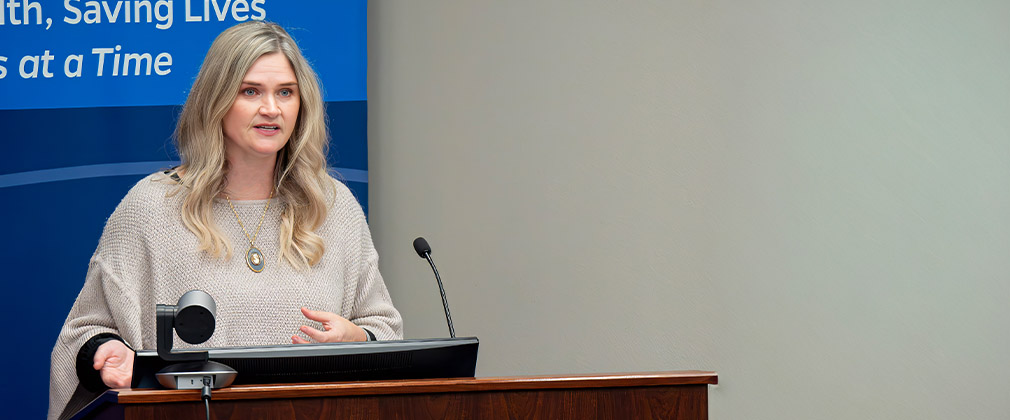
How to Build Power: Connect Science, Law, and Policy
BALTIMORE—December 15, 2025. “Industrial agriculture has redefined efficiency as separation—separation from land, from animals, and from people,” said Jessica Culpepper at the start of her talk for the Johns Hopkins Center for a Livable Future’s 22nd Annual Edward and Nancy Dodge Lecture. The annual lecture features a distinguished visiting scholar to address the public health implications of food systems change.
Culpepper, is the Executive Director of FarmSTAND, where she leads the organization to fight for a fair food system in courtrooms and communities. Her 18-year career has focused entirely on advocating on behalf of farmed animals and communities harmed by industrial animal agribusiness. She began her talk by explaining how industrial agriculture extracts life and profit from every connection that it severs, and that the disconnection serves the industry well.
Reconnecting what’s been severed is part of her mission. Early in her career, she was told by Steve Wing, an epidemiologist and professor who championed communities affected by industrial livestock operations, that researchers need lawyers like her. It was through a court case in Yakima Valley, Washington, that she had her first experience of the power of law and public health when they unite.
“I learned that science, public policy, and law were not separate languages,” she said.
In that case, Culpepper worked for the plaintiff, the Community Association for Restoration of the Environment (CARE), which sued Cow Palace and four other mega-dairies. The plaintiffs won. Helping them to victory was the Center for a Livable Future’s (CLF) founding director, Bob Lawrence, who testified that the pollution created by the mega-dairies in Yakima Valley was a public health crisis. “He connected the dots,” said Culpepper.
“The industry had legal invisibility, and they enjoyed it for decades,” she said. “But with this ruling, now the communities had a new tool. And the ruling brought real relief.”
As a result of the court victory, the mega-dairies were compelled to line the manure “lagoons,” to provide clean water to residents, and more.
On the heels of the success in the courtroom, the battle moved to Capitol Hill. Culpepper remarked that she learned in Yakima that when you build new tools, industry will respond by trying to take them away. After the courtroom victory, at the very next opportunity, the mega-dairy industry helped to elect US Representative Dan Newhouse, who immediately introduced the Farm Regulatory Certainty Act, which was designed to prevent citizens from suing livestock operations for manure pollution. Fortunately, Culpepper was part of a coalition that stayed connected beyond the legal case—she was part of a network of farmers, organizers, workers, and fenceline communities. They pushed back, and the bill did not pass.
“The only way to sustain victory is through a toolbox with multiple tactics,” said Culpepper. “It’s really through connection.”
Among the most important elements of those connections listed by Culpepper are trust, evidence, and partnership with the people who are most affected. Telling stories is paramount, she said. “Every time we win in one arena, we have to be ready to fight in another, and when those stories are told, power listens.”
Law, activism, and public health are intersecting paths, she said, not parallel. Researchers contribute by making science understandable to lawyers and judges, and by translating harm into evidence that can be used. Activists and legal advocates can let researchers know what kind of evidence they need. To succeed, she said, all the stakeholders must build connections in a system designed to keep them apart; they must work together toward a shared goal. Building trust is the first step. Relationship building comes soon after that. Furthermore, communities don’t always trust lawyers, and litigation in a vacuum fails, which is why legal advocates need organizers and activism—and scientists.
“If you frame harm through a public health lens, through collective risk, we can move things,” she said. “Storytelling builds real power.”
Evidence and stories—these are the tools needed to demand accountability, said Culpepper.
“We can turn knowledge into change,” she said. “The path is long, but we walk it together.”
About Jessica Culpepper
Jessica Culpepper is the Executive Director of FarmSTAND, leading the organization’s staff and board to fight for a fair food system in courtrooms and communities. Jessica’s 18-year career has been entirely focused on legal advocacy on behalf of farmed animals and communities harmed by industrial animal agribusiness. Her fight for a fair food system began at her alma mater, Warren Wilson College, a work college with a sustainable working farm and garden. Before leading FarmSTAND, she worked at Humane World for Animal's Farmed Animal Welfare Division and was the Director of the Public Justice Food Project. As a lawyer, Jessica worked primarily on fighting pollution from factory farms with fenceline communities and advocating for federal and state policy reform to advance fair food systems. Jessica stays deeply tied to the fight for a fair food system in her personal life as well, as chair of the board of Socially Responsible Agriculture Project and as a board member of Warren Wilson College and Friends of the Earth.
About the Edward and Nancy Dodge Lecture
The Edward and Nancy Dodge Lecture is supported through the R. Edward Dodge, Jr. and Nancy L. Dodge Family Foundation Endowment, established through the generosity of Dr. Edward Dodge, MPH ’67, and his late wife Nancy to provide core funding for the Center for a Livable Future.